
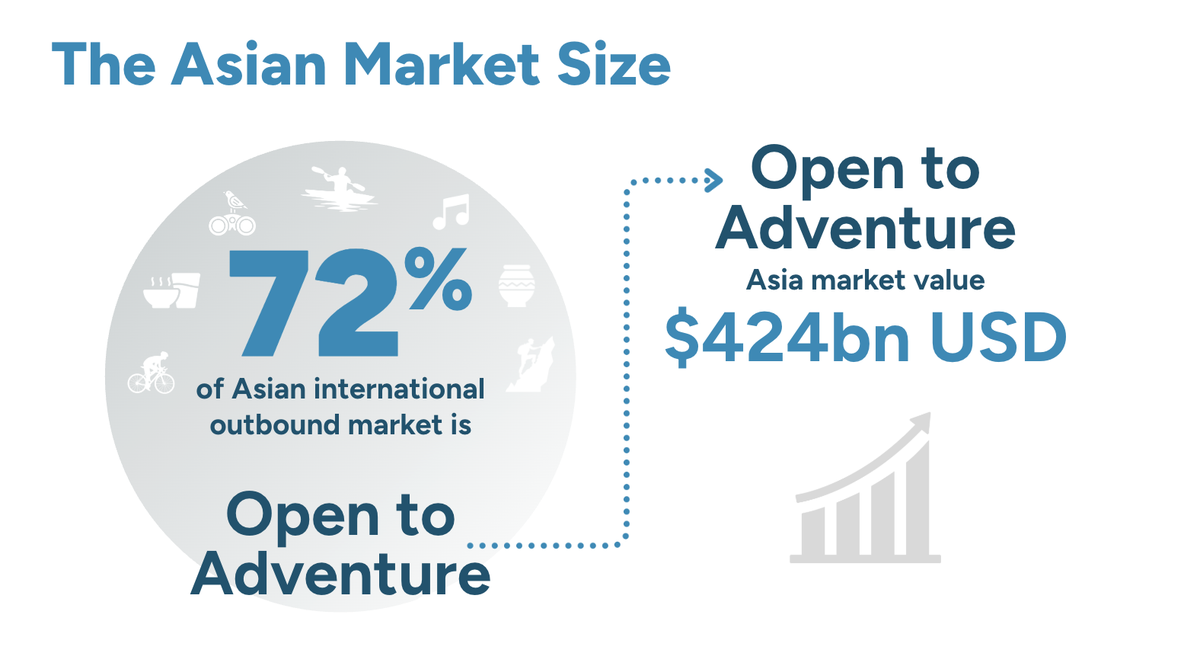
Adventure travel is entering a new era of global growth, and Asia is emerging as one of its most powerful drivers. According to a new report from the Adventure Travel Trade Association (ATTA), supported by EF Adventures and CBI, Asia’s outbound “Open to Adventure” travel segment represents an estimated $424 billion market, almost a third of the world’s total adventure travel value, reflecting both the scale of the region’s travelers and the evolving ways they approach travel experiences.
The research shows that 72% of Asia’s international outbound travelers fall into the “Open to Adventure” category, meaning they are willing to incorporate activities such as cultural exploration, nature experiences, and active discovery into their trips, even when adventure is not the primary reason they travel. This is the highest percentage of cultural travelers across all global regions, contrasting the often-held belief that Asian travelers prefer large, loud, and highly scheduled tour groups.
This shift reflects a broader transformation in how adventure travel is defined. What was once associated mainly with physically demanding activities is now expanding into a wider set of experiences that combine exploration, learning, culture, and personal enrichment.
“Adventure travel in Asia is no longer about a single activity or adrenaline-driven pursuit,” said Heather Kelly, Director of Research and Knowledge at the Adventure Travel Trade Association. “What we’re seeing instead is a large and diverse audience that is open to discovering destinations through culture, landscapes, and meaningful experiences. That openness dramatically expands the opportunity for destinations and tourism businesses.”
Acknowledging the importance of the Asian outbound adventure travel, the ATTA has hosted three webinars to learn more about Chinese, Indian, and Japanese adventure travelers.
Access the Asian Traveler Report
Asia’s Growing Influence in Global Adventure Travel
Globally, outbound adventure travel is estimated to represent $1.16 trillion in value, and Asia is playing an increasingly influential role in that growth. Rising incomes, expanding middle classes, and greater international connectivity have combined to fuel a rapid increase in outbound travel across the region. At the same time, travelers are increasingly prioritizing trips that feel purposeful, memorable, and personally enriching.
The ATTA research highlights that adventure travel in Asia is evolving alongside these broader lifestyle changes. For many travelers, adventure is no longer defined by extreme activities but by experiences that allow them to engage more deeply with destinations. These might include hiking in natural landscapes, exploring local food traditions, connecting with communities, or discovering heritage and history. The common thread is a desire for journeys that feel immersive and authentic rather than purely observational.
Four Ways Asian Travelers Engage with Adventure
The report identifies four key traveler segments that together shape Asia’s adventure-oriented market:
- Adventure Intensives (17%), travelers seeking physically active and immersive experiences
- Nature Enthusiasts (13%), motivated primarily by outdoor environments and wildlife
- Cultural Explorers (28%), who prioritize heritage, food, and cultural learning
- Experience Samplers (14%), travelers who blend elements of culture, activity, and relaxation
Rather than representing rigid categories, these segments illustrate the different ways travelers incorporate adventure into their trips. Many travelers shift between them depending on the destination, travel companions, and purpose of the journey.
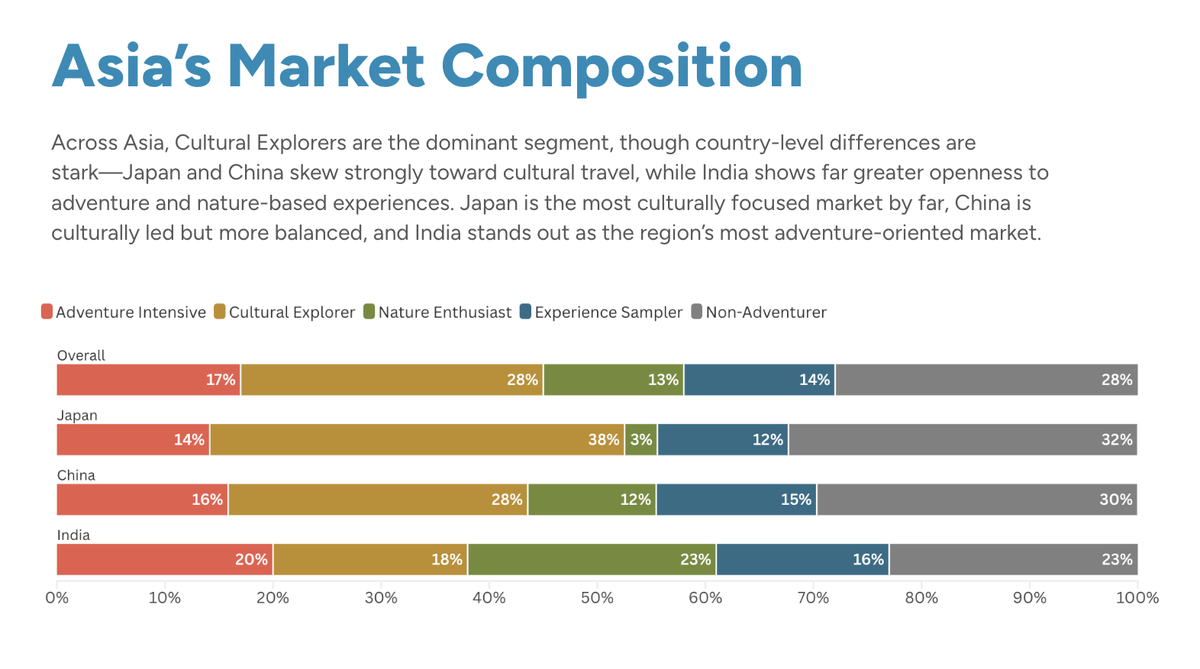
Across Asia, cultural exploration has emerged as a central pillar of adventure travel. Travelers increasingly expect opportunities to engage with local traditions, cuisine, and communities as part of their experiences. Authentic cultural interaction, once considered a niche offering, has become a baseline expectation for many travelers.
Access the Asian Traveler Report
Spending Patterns Reflect Strong Economic Impact
Asian outbound travelers also represent a significant economic force for destinations. The research highlights how different markets contribute value in different ways. For example, Indian travelers tend to take the longest trips, while Japanese and Chinese travelers often spend more per night, creating different types of economic impact across destinations.
Across the markets studied, travelers spent an average of about $336 per adult per night, with total trip spending averaging more than $2,200 per traveler. Importantly, a significant portion of this spending flows directly to local businesses, underscoring the economic importance of adventure-oriented travel experiences that involve guides, cultural encounters, local food, and community-based tourism.
The Rise of Meaningful and Responsible Travel
Another major trend highlighted in the report is the growing importance of sustainability and responsible tourism. While environmental and social responsibility are not always the primary factors in destination selection, Asian travelers show strong openness to travel practices that support local communities and protect natural environments. This includes actions such as choosing locally owned businesses, participating in cultural experiences that support communities, and seeking destinations that demonstrate environmental stewardship.
“Sustainability is increasingly intertwined with how travelers define a meaningful trip,” said Hannah Pearson, Regional Director for APAC at the ATTA. “When you look at a $424 billion adventure-oriented travel market coming out of Asia, the trends become clear: travelers want authentic cultural experiences, nature-based exploration, and opportunities to travel in ways that feel responsible and enriching.”
Designing for the Adventure-Curious Traveler
For destinations and tourism businesses, the findings suggest a need to rethink how adventure travel is positioned. Rather than focusing solely on high-intensity activities, the opportunity lies in creating experiences that combine cultural storytelling, nature-based exploration, and opportunities for personal connection.
“The Asian outbound traveler is incredibly curious,” said Gustavo Timo, ATTA’s President. “They’re looking for experiences that feel meaningful, whether that’s exploring landscapes, connecting with local culture, or discovering new perspectives. Destinations that design journeys around those elements will resonate strongly with this audience.”

Importantly, Asian travelers also balance their desire for discovery with practical considerations such as comfort, quality, and reliability. Trips that successfully combine immersive experiences with a high standard of service are particularly well positioned to succeed in the market.
A Defining Moment for Adventure Travel
Taken together, the report’s findings point to a major shift underway in global tourism. Adventure travel is expanding beyond its traditional niche and becoming a central framework for how many travelers approach exploration.
In Asia, where outbound travel continues to grow rapidly, that shift is particularly pronounced. The region’s travelers are increasingly seeking journeys that combine cultural discovery, natural beauty, and meaningful personal experiences. For destinations around the world, understanding this evolving mindset may be the key to capturing one of the most dynamic travel markets of the coming decade.