
Adventure travel is no longer a niche category defined solely by adrenaline-fueled activities. Across Latin America, a broader and more diverse group of travelers is embracing experiences that blend culture, nature, exploration, and personal growth. This shift is reshaping the region’s outbound tourism landscape and creating new opportunities for destinations and operators across North America. To learn more about the Latin America market, join ATTA in June at AdventureELEVATE Latin America 2026.
New research from the Adventure Travel Trade Association (ATTA), supported by EF Adventures and CBI, estimates that Latin America’s outbound “Open to Adventure” travel segment represents a $39 billion market, accounting for nearly half of the region’s international outbound travel. Learn more about the other regional segments here.
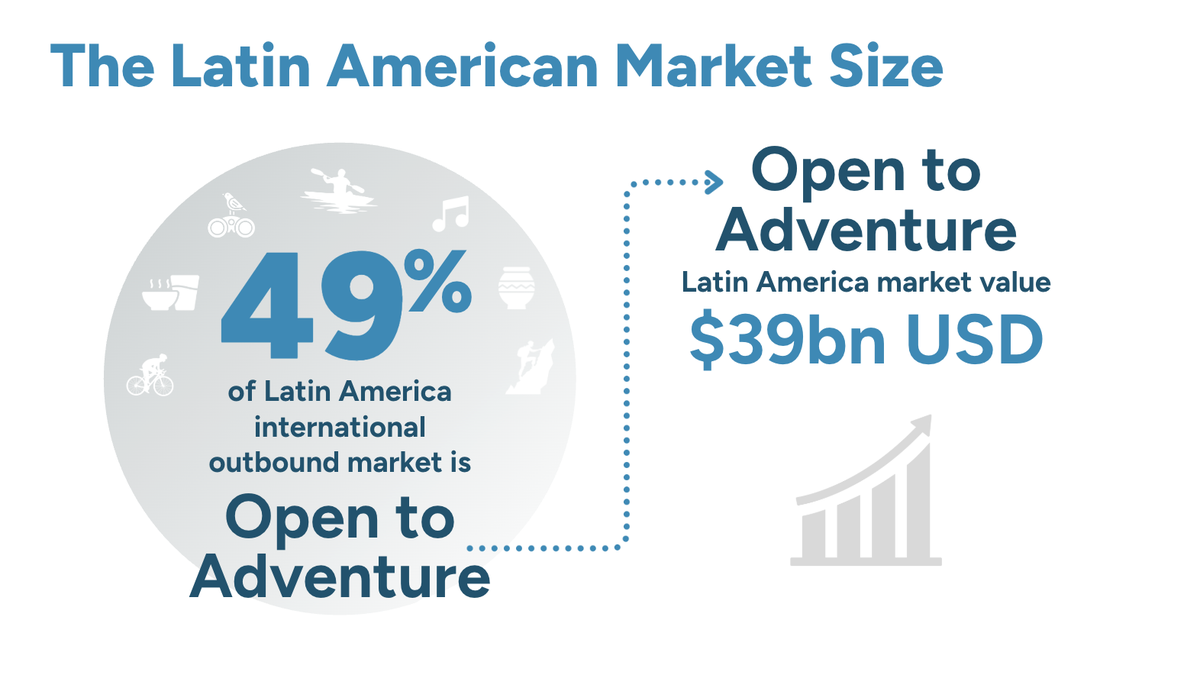
“With an estimated $39 billion in outbound adventure travel spending, the Latin American market represents a major opportunity for destinations and tourism businesses. The key is understanding that these travelers are looking for experiences that combine exploration with quality, comfort, and trust in the overall journey. They prefer local or national accommodations and DMCs, and local guides, to enjoy an authentic experience in the destinations they visit” says Nicolas Caram, ATTA’s Vice President for Destination and Business Development.
Rather than being defined by extreme activities alone, the “Open to Adventure” traveler represents a much larger mainstream audience of people who are willing to incorporate active, cultural, or nature-based experiences into their trips even when adventure is not the primary motivation.
Access the Latin American Traveler Report
Adventure Travel Goes Mainstream
The evolution of adventure travel over the past decade has expanded its reach well beyond traditional adventure enthusiasts. While activities such as hiking, kayaking, and wildlife encounters remain important, travelers increasingly seek deeper experiences rooted in culture, food, heritage, and meaningful engagement with place.
According to Gustavo Timo, ATTA’s President, “Latin American travelers are incredibly curious about the world. They want trips that feel meaningful, whether that’s through culture, landscapes, food, or local connection. Destinations that design experiences around authenticity and storytelling will resonate strongly with this market.”
Latin American travelers are particularly motivated by this combination of exploration and enrichment. Adventure and exploration and cultural immersion rank as the leading travel motivations, closely followed by personal growth and transformation.
This blend of motivations highlights an important shift: travelers are not simply looking for thrills. Instead, they want journeys that help them connect with new cultures, learn about local traditions, and return home with stories worth sharing.
Four Distinct Traveler Segments
To better understand the diversity within the market, the research identifies four traveler segments that collectively represent Latin America’s adventure-oriented audience:
- Adventure Intensives (12%), travelers seeking physically active and immersive experiences
- Nature Enthusiasts (12%), motivated by outdoor environments and wildlife
- Cultural Explorers (24%), the largest segment, driven primarily by learning and cultural immersion
- Experience Samplers (4%), travelers interested in blending elements of culture, nature, and activity
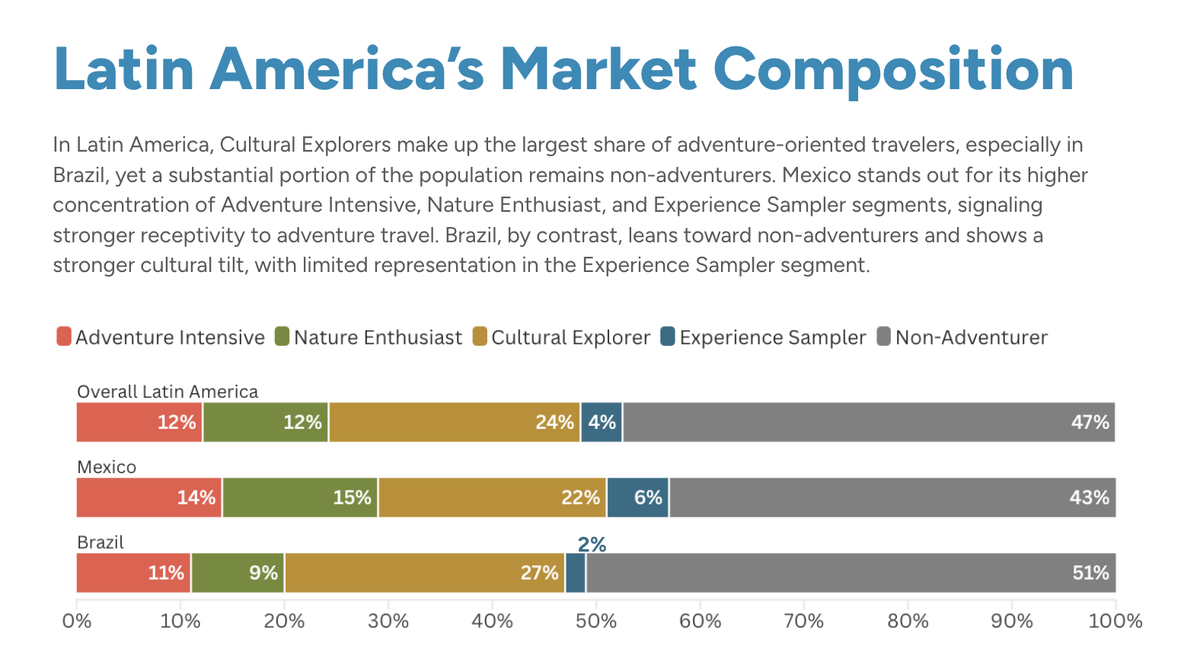
Among these groups, Cultural Explorers dominate the Latin American market. These travelers prioritize heritage, history, cuisine, and cultural exchange while still expressing interest in light adventure activities such as walking tours, nature excursions, and outdoor exploration.
Importantly, these segments are not rigid identities. Travelers often move between them depending on the destination, trip purpose, and travel companions.
Access the Latin American Traveler Report
Mexico and Brazil as the Focus
The research focuses particularly on Mexico and Brazil, the two largest outbound markets in the region. Mexico shows a relatively balanced distribution across the adventure-oriented segments, indicating broad openness to different types of adventure travel. Brazilian travelers, meanwhile, show a stronger concentration in Cultural Explorers and a slightly larger share of travelers who do not identify strongly with adventure travel.
Spending patterns also reflect a meaningful economic impact. On recent trips, Latin American travelers spent a median of around $225 per adult per night, with roughly 40% of travel spending going to local businesses.
North America as a Preferred Destination
For Latin American outbound travelers, destination choices strongly favor globally recognized and well-connected markets. The United States leads intended travel destinations, followed by Western Europe and Mediterranean countries.
Canada also ranks among the top destinations, reflecting a mix of accessibility, reputation, and opportunities for nature-based exploration.
This preference highlights the importance of connectivity and perceived ease of travel. Well-established tourism infrastructure and globally recognized attractions continue to play a major role in shaping destination decisions.
The Balance Between Enrichment and Reassurance
One of the most notable findings in the research is what analysts describe as an “enrichment–reassurance balance.”
Latin American travelers are eager for immersive experiences, but they also prioritize factors such as safety, quality, and comfort when choosing where to travel. In many cases, reassurance about the overall experience matters as much as the experience itself.
Quality and comfort rank among the most important considerations during trip planning, alongside safety and cost. Travelers want to feel confident that their trips will be well organized, secure, and enjoyable.
For destinations and tour operators, this means that authentic experiences must be paired with visible signals of reliability and professionalism.
Sustainability as a Practical Choice
Sustainability is another emerging theme among Latin American travelers. While it is rarely the primary factor influencing destination choice, many travelers express willingness to adopt responsible practices when they are easy to incorporate.
Actions such as reducing waste, supporting locally sourced products, and traveling during off-peak seasons resonate strongly with this audience. Rather than viewing sustainability as a separate initiative, successful destinations often integrate responsible practices directly into the travel experience.
A Growing Opportunity for Destinations
Taken together, these trends point to a growing opportunity for destinations seeking to attract Latin American travelers.
Adventure travel in the region is increasingly defined by experiences that combine culture, nature, and light-to-moderate activity, rather than extreme adventure alone. Destinations that offer meaningful local connections, compelling cultural narratives, and well-organized travel experiences are likely to resonate most strongly.
Heather Kelly, ATTA’s Director of Research and Knowledge says, “Adventure travel in Latin America is evolving beyond the stereotype of high-adrenaline activities. What we’re seeing instead is a large and growing audience of travelers who are open to exploring culture, nature, and local communities as part of their trips. That shift is expanding the definition of adventure and the size of the opportunity.”
For tourism businesses, the message is clear: the Latin American outbound adventure market is large, growing, and increasingly mainstream. Understanding the motivations and expectations of the “Open to Adventure” traveler will be key to capturing its full potential.