
During a summer in which heat waves and wildfires have disrupted communities and travel across Europe and North America, a new study on how travelers feel about sustainability is particularly timely.
For years, the sustainability-minded traveler has been treated as a distinct and relatively small segment, a group to plan around rather than to build for. A new joint research report from the Adventure Travel Trade Association, climate platform Wren, the United States Tour Operators Association, and MMGY Global suggests that this framing no longer holds. Titled "How Climate-First Travelers Reveal the Future of Sustainability in Travel," the report brings together five separate datasets spanning both traveler and trade perspectives, and it arrives at a clear conclusion: travelers are converging on sustainability faster than the industry has assumed, and the traveler who once looked like a niche is quickly becoming the mainstream.
A Signal Across Five Datasets
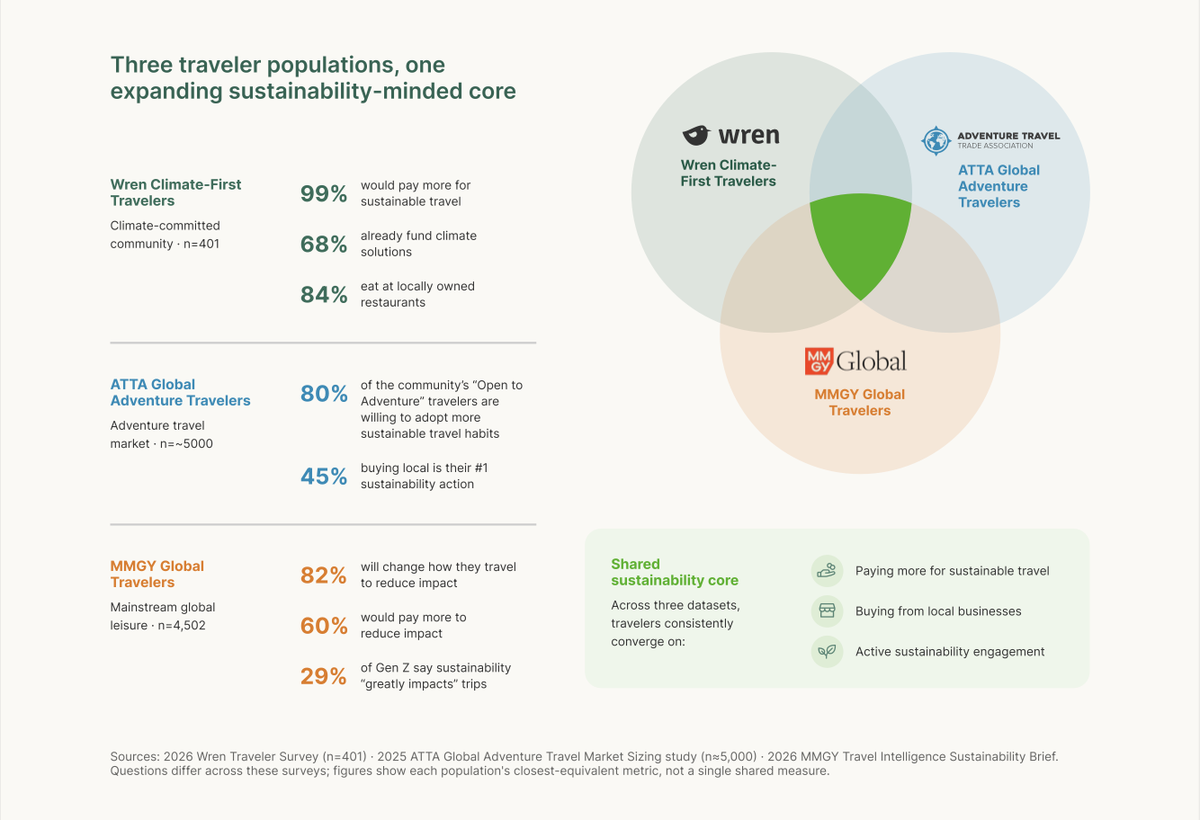
The report draws on the 2026 Wren Traveler Survey of 401 climate-committed travelers (see Appendix 1 for results), the 2025 ATTA Global Adventure Travel Market Sizing study of roughly 5,000 travelers across 13 countries, the 2026 MMGY Travel Intelligence Sustainability Brief tracking 4,502 U.S. adults alongside European, APAC, and Latin American panels, the 2026 ATTA Adventure Travel Trends and Insights survey of 329 operators, and the 2024 USTOA/PwC Economic Impact Study covering roughly 50 of the largest U.S. tour operators.
These five populations differ meaningfully in size, geography, business model, and motivation, and that difference is what gives the findings weight. A focused community of climate-committed travelers, the broad global adventure market, and the mainstream American leisure traveler do not typically share the same priorities. When they nonetheless land on the same handful of behaviors, the result points to a genuine, broad-based movement rather than the preference of an early-adopter few.
Traveler Attitudes Are Converging
Willingness to pay more for sustainable travel is rising across every population studied. It is near-universal within Wren's climate-committed community, at 99 percent, and it has reached 60 percent in MMGY's general U.S. leisure sample, up from 56 percent in 2024 and 57 percent in 2025. Among Gen Z it climbs to roughly 81 percent, and in APAC and Latin America it runs from 84 to 87 percent. Willingness to change behavior is higher still, with 82 percent of mainstream travelers saying they will adjust how they travel in order to reduce their impact.
The most important pattern is generational. In MMGY's mainstream sample, sustainability greatly impacts the travel decision for 29 percent of Gen Z and 25 percent of Millennials, compared with 10 percent of Gen X and 3 percent of Boomers. Gen Z is the largest generation ever recorded, and together with Millennials it is projected to account for more than half of all U.S. leisure trips by 2030, up from roughly one-third in 2023. The travelers aged 25 to 44 who are driving today's numbers are moving into their peak earning and travel years. As they do, the expectations they carry will shift from a niche to serve into a baseline to meet.
What Climate-First Travelers Already Do
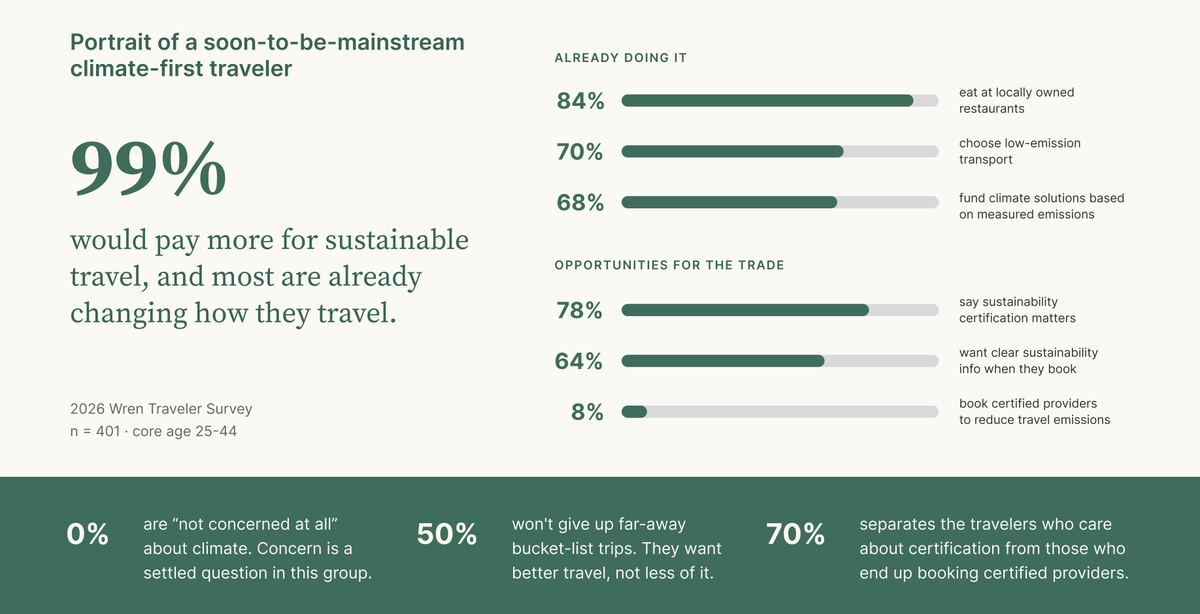
The report's portrait of the climate-first traveler is notable because it describes behavior, not intention. Within the Wren community, 68 percent already fund climate solutions based on the measured emissions of their trips, 70 percent choose lower-emission transport such as trains and buses, and none describe themselves as not concerned at all about climate.
Spending locally is simply the default. Eighty-four percent eat at locally owned restaurants, 66 percent buy locally made products, 55 percent stay in locally owned accommodations, and 41 percent hire local guides. The same instinct runs through the broader adventure market, where consuming locally sourced products is the single most-cited sustainability action in both North America and Europe. For this traveler, directing spend into the destination is not a virtuous extra. It is standard practice.
One qualifier sharpens the picture. Travelers pay most readily when sustainability arrives as a better experience, one that is more local, more authentic, and less crowded, rather than as a sacrifice. Even among the most climate-motivated travelers, half say the far-away, bucket-list destination is what they would most miss if asked to give something up. The appetite is for a better trip, not a smaller one, and that distinction should guide how the trade designs and describes its products.
Where the Trade Is Already Strong
The two operator datasets describe an industry that is already deeply invested in sustainability, even where it does not always name it as such. Both groups build their work on the same foundation: sourcing from responsible suppliers and directing spend and benefit to local communities. Sourcing from sustainable suppliers is the most common action among ATTA operators, at 57 percent, and 75 percent of USTOA members name aligning with their supply chain and partners as a priority. Supporting local communities ranks at or near the top for both.
The local economic engine is real and substantial. Adventure operators already channel roughly 75 percent of every trip dollar, about $1,688 of a typical $2,250 trip, back to local suppliers, plus an average of $263 per guest on local handicrafts. This is sustainability in its social and economic dimensions, delivered where destinations feel it most. For a membership made up largely of small businesses, it tends to live in daily practice rather than in a formal strategy document, which is part of why it so often goes unspoken.
The Gap at the Booking Moment
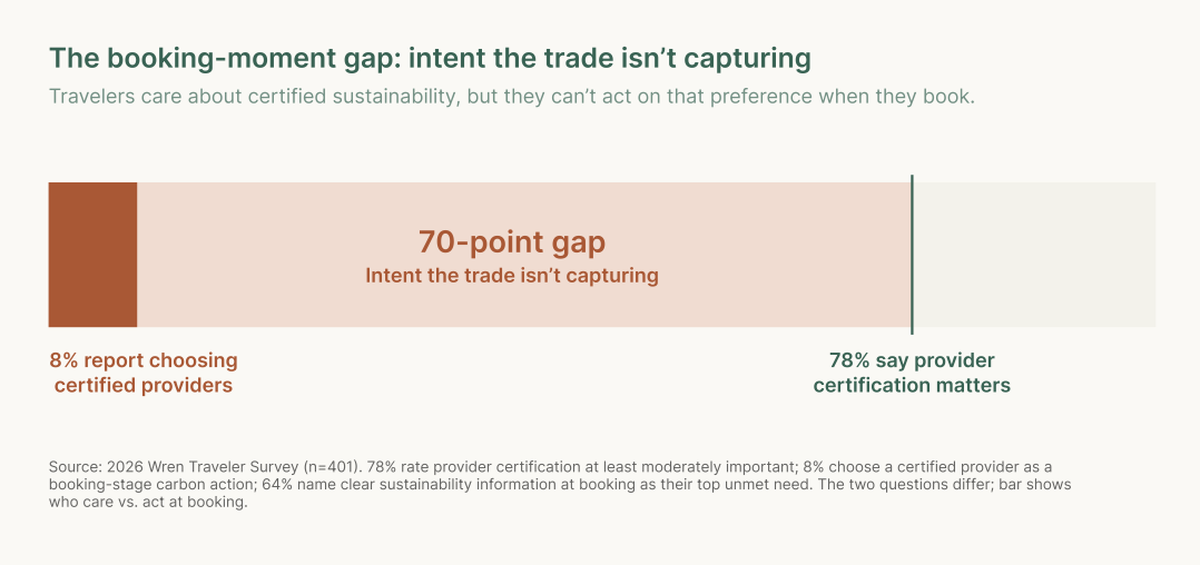
The report's most actionable finding concerns communication. Within the Wren community, 78 percent say a provider's certification is at least moderately important, yet only 8 percent actually choose a certified provider when they book. Sixty-four percent name clear sustainability information at the point of booking as their single greatest unmet need. The intent is present. What is missing is the signal, at the moment of decision, that would let travelers act on it.
Operators already hold the information these travelers are asking for, including supplier networks, local-spend figures, certification status, and climate programs. It simply tends to remain in brochures and footnotes rather than on the booking page. In the mainstream, the same gap appears as a question of trust, with 29 percent of MMGY travelers saying they do not trust sustainability claims and relying instead on personal recommendations, reviews, and third-party certification, which are precisely the credibility signals the trade has not yet learned to surface at scale.
Climate belongs in the same conversation. It has slipped down operator priority lists, ranking fourth for both ATTA and USTOA members as rising costs and geopolitical pressures moved to the front. The report reads this as a response to near-term economic conditions rather than a change in conviction, and it anticipates that tightening disclosure regulation and rising customer expectations will pull climate back up. Operators that maintain their climate and certification work through this period will be better positioned than those that pause it.
Looking Ahead
Read separately, the five datasets are five different conversations. Read together, they offer fresh perspective and guidance for the travel industry. Travelers are arriving at sustainability faster than the industry expects, and while the trade is already doing substantive work, there are simple ways to close the distance between the two.
The opportunities are practical and within reach. Make sustainability visible at the booking moment, where the decision is actually made. Tell the local economic story with named suppliers, guide profiles, and honest local-spend figures, which requires no change in price and no new partners. Build a certified, climate-inclusive premium tier for the meaningful share of the travel market that is ready for it. Design with women in mind, given that they hold higher expectations for certification and stronger local-spending habits yet remain underserved. Rather than leading with a message to fly less, build sustainability into long-haul travel through direct routing, longer local stays, certified accommodation, and pricing that funds climate solutions as part of the trip. And begin building a machine-readable sustainability data layer now, so that operators are discoverable as AI-assisted trip planning matures.
None of this asks operators to become something they are not. It asks the industry to be recognized for what it already is. The convergence this report describes can complete itself in the way our community would want, with travelers and the trade meeting in the middle, and it will happen soonest for the businesses that treat communication and climate as this year's work rather than next year's.
Explore the Findings With the Research Partners
ATTA, Wren, USTOA, and MMGY Global will walk through the full findings and what they mean for operators in a dedicated webinar on 20 August 2026, with time to bring your own questions. It is the best way to move from these headlines to the specific steps you can take within your own business.