
The Adventure Travel Trade Association (ATTA) has released its 2026 Adventure Travel Trends & Insights report, drawing on global survey data collected between January and March 2026 to reflect operator performance and sentiment from 2025. After years of rapid post-pandemic recovery, the adventure travel sector is entering a more measured phase, defined by resilience, recalibration, and strategic adaptation.
Now in its 19th year, the report continues to serve as a benchmark for tracking the direction and performance of the global adventure travel sector. A total of 329 tour operators participated, representing businesses headquartered across South America, Europe, North America, Asia, and beyond.
Growth Continues, Though at a Slower Pace
The latest findings point to an industry that continues to grow, though at a more moderate pace. Most operators reported revenue increases in 2025, generally at incremental levels, while a slightly higher share experienced declines and overall trip volumes softened.
These shifts suggest a change in how growth is being achieved, with operators focusing less on volume and more on efficiency, margins, and diversified offerings. At the same time, key operational indicators remain stable, and the sector continues to be defined largely by small businesses.
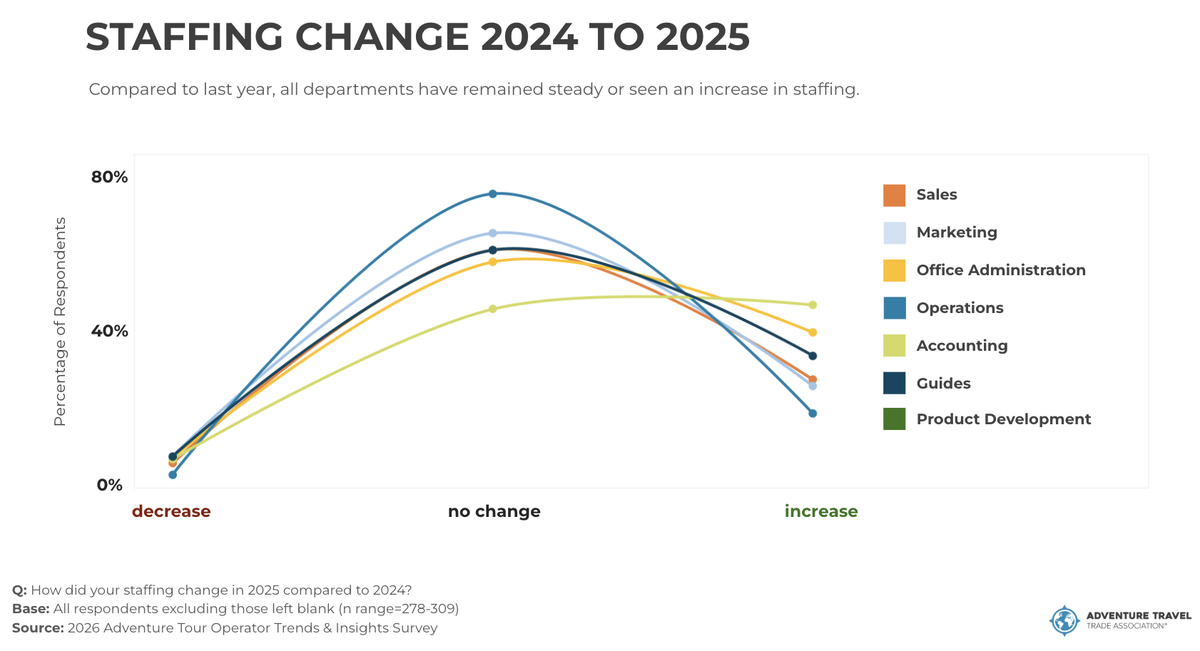
While steady performance can signal stability, in a growing global travel market it also raises important questions. Flat fill rates may indicate capacity is expanding in line with demand, or that competition and fragmentation are limiting gains. For operators, this underscores the importance of yield management, differentiated offerings, and stronger distribution strategies to improve per-departure performance rather than relying on rising demand alone.
Looking ahead, ATTA data suggests the sector is entering a more disciplined growth phase, where profitability, resilience, and long-term sustainability are becoming more important than rapid expansion. Sixty-one percent of respondents anticipate higher net profits in 2026, though confidence has softened slightly compared to last year. Operators expecting declines point to political instability, regional conflict, and rising overhead as primary concerns.
According to ATTA CEO Shannon Stowell, “After several years of rapid recovery, what we’re seeing now is a normalization of the sector, one that is healthier and more sustainable long term. Growth has not stopped, but it is becoming more intentional. Operators are focusing less on volume and more on building resilient, well-balanced businesses.”
Join ATTA at an Upcoming Event to Discuss These Results
Pricing Adjusts Across a Diverse Market
The median price of operators’ most popular itinerary declined in 2025, alongside a decrease in average group sizes, pointing to a shift in how trips are structured rather than a drop in demand. Operators appear to be focusing on smaller groups, more tailored experiences, and diversified offerings while maintaining revenue growth.
While pricing varies widely across the sector, the overall range highlights the diversity of adventure travel experiences. “The data shows that success in today’s market is not about running bigger trips, it is about running better ones. Smaller groups, more tailored experiences, and stronger cost control are becoming key drivers of profitability,” says ATTA President Gustavo Timo.
Remote and expedition-style travel continues to command higher price points, while more accessible itineraries are attracting a growing segment of cost-conscious travelers.
Adventure travel continues to deliver strong economic benefits at the destination level, with a significant share of trip revenue remaining in local economies. As in recent years, approximately 75% of trip revenue stays within the local economy, with travelers also spending an average of $263 on handicrafts and souvenirs.
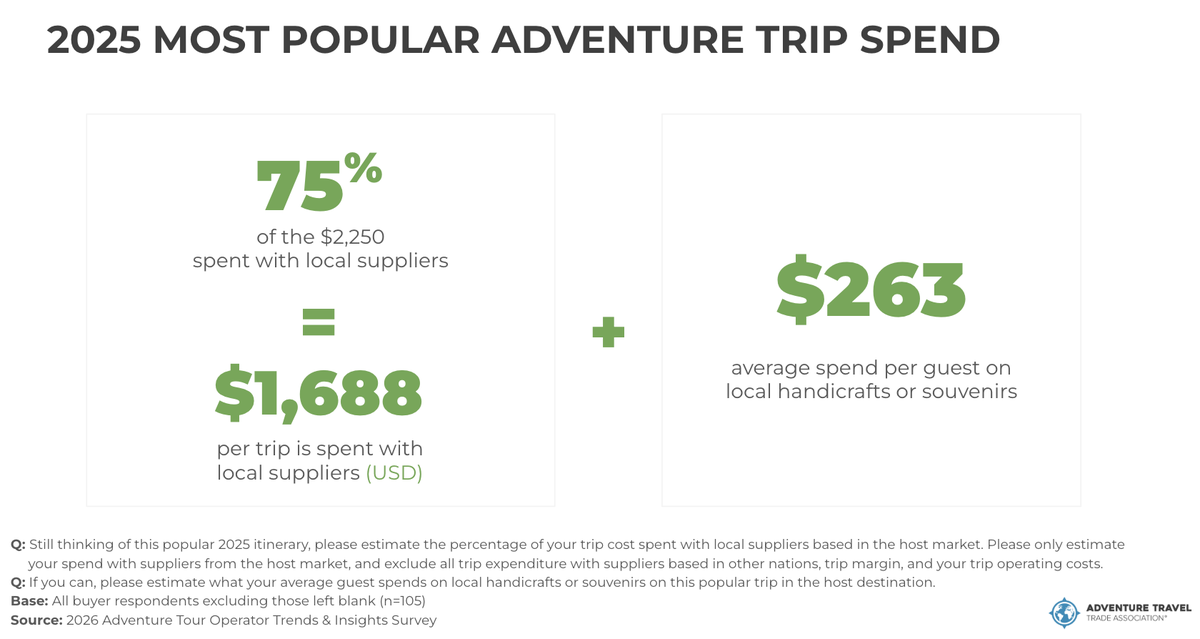
This reinforces adventure travel’s role as a high-impact economic driver, delivering direct, localized benefits at a scale few other tourism segments can match. For operators, this is increasingly a strategic advantage, strengthening their position when engaging with destination partners, policymakers, and sustainability-conscious travelers.
Activity Trends Reflect Evolving Demand
Hiking, trekking, and walking remain the most in-demand activities globally, maintaining their top position year over year. Culinary and gastronomy experiences climbed to second place, continuing their upward trajectory, while cycling with electric bikes, cultural experiences, and wellness rounded out the top five.
Regional patterns show notable continuity with some shifts in emphasis. Electric bike cycling continues to lead in Europe and North America, while South America operators again rank hiking first, followed by culinary travel. In Asia, cultural experiences and camping remain key draws.
On the destination side, North-East Asia and Scandinavia emerged again as top trending regions, reinforcing demand for less crowded, climate-resilient destinations. Canada, southern South America, and Western Europe also ranked highly, while interest in the United States and Russia declined compared to prior results.
Demand continues to center on customized trips, soft adventure, and expert-led experiences, alongside growing interest in low-impact itineraries and women-focused travel.
Sustainability Gains Ground, With Familiar Challenges
Progress on sustainability certification continues, with more than half of operators now holding or working toward certification, and widely recognized frameworks, particularly Travelife and B Corporation, remaining the most common choices. Travelife’s role is further reinforced through its partnership with ATTA, helping support sustainability education and certification pathways across the sector.
Contributions to protected areas vary widely across operators, though the largest share report contributing more than $50 per traveler per trip.
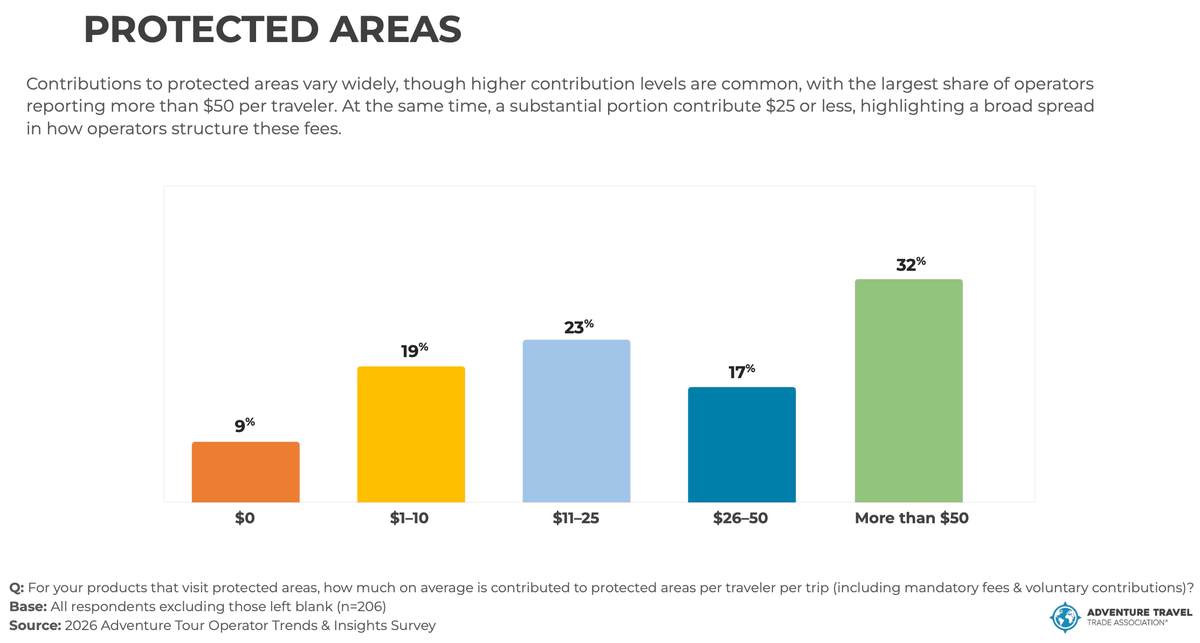
Operators remain motivated by environmental protection, community well-being, and local economic support, though persistent barriers, particularly cost, time, and uncertainty, continue to limit progress. Adoption of more sustainable practices is gradually increasing, alongside ongoing focus on key issues like wildlife protection, community livelihoods, climate change, and safety preparedness.
Marketing Mix Stabilizes as Partnerships Rebound
Word of mouth remains the most effective marketing channel, with social media, partnerships, and trade shows also playing important roles in how operators reach travelers. Direct bookings continue to make up the majority, while partnerships and agents represent a significant and growing share of bookings.
Marketing budgets are holding steady, with social media platforms continuing to play a central role in connecting with travelers. Together, these trends point to evolving traveler expectations and the continued importance of building trust and strong connections throughout the booking journey.
A More Measured Phase of Industry Growth
Overall, this year’s report reflects an industry stabilizing after a period of rapid change, with operators taking a more measured, long-term approach to growth. Compared to last year, the data shows greater consistency across key indicators alongside incremental progress in sustainability, product development, and market diversification.
“What stands out this year is not just continued growth, but how that growth is evolving. The industry is becoming more disciplined, prioritizing long-term value, community impact, and operational resilience over short-term expansion,” says Heather Kelly, Director of Research and Knowledge at ATTA.
The result is a sector that remains resilient and adaptive, while increasingly focused on sustainable, steady growth.