
Adventure travel is a global trend, but in Europe it takes on distinct national flavors. New research from the Adventure Travel Trade Association (ATTA), supported by EF Adventures and CBI, examining outbound adventure travelers from France, Germany, Italy, the Netherlands, Spain, and the United Kingdom shows that while adventure has become mainstream across the region, the motivations and travel styles behind it vary significantly from country to country. These outbound markets were selected because together they represent some of Europe’s largest and most influential outbound travel markets, while also reflecting a diversity of travel cultures within the region. To learn more about the European market, join ATTA in May at AdventureELEVATE Catalonia 2026.
Access the European Traveler Report
Across these six markets, roughly 73% of international outbound travelers are considered “open to adventure,” representing an estimated $464 billion market. Learn more about the other regional segments here.

But being open to adventure does not mean the same thing everywhere. Some markets prioritize cultural immersion, others emphasize active exploration, and some balance both.
“With an estimated $464 billion in outbound spending, Europe represents one of the largest adventure travel markets in the world,” said Gustavo Timo, President of ATTA. “But it’s not a single, uniform market. Each country brings its own travel culture and motivations, and destinations that recognize those differences will be best positioned to capture this opportunity.”
Adventure, European Style
One of the clearest findings from the research is that European travelers rarely define adventure solely by extreme activities. Instead, adventure trips often combine culture, nature, and exploration with shared experiences and personal enrichment.
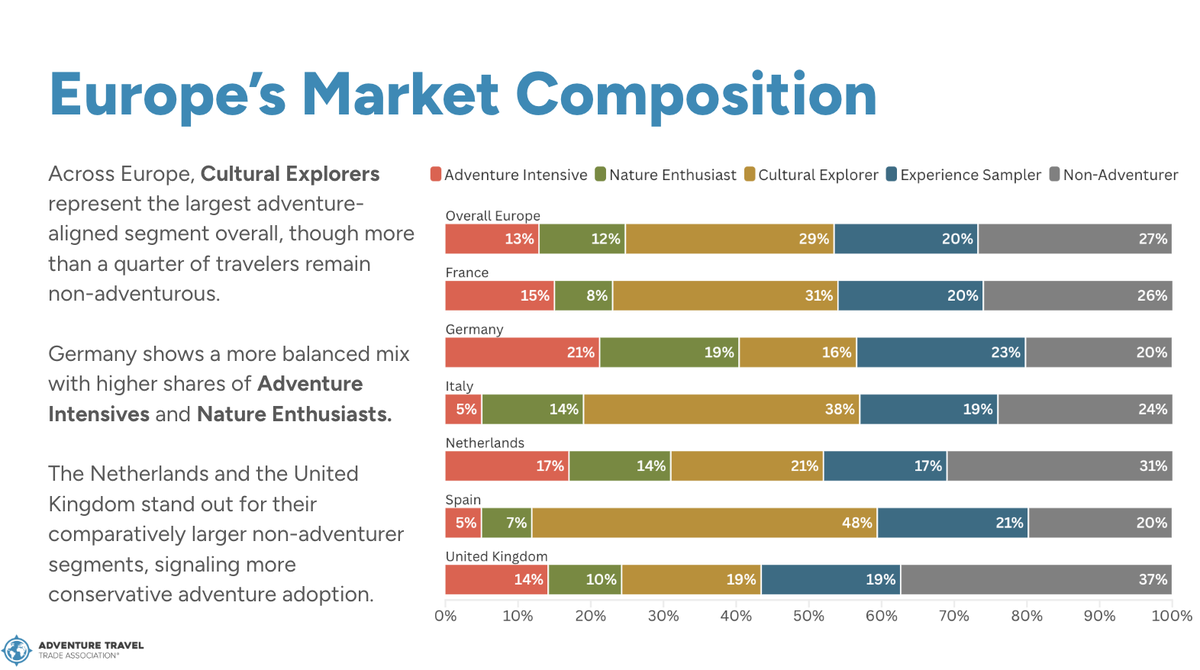
Across Europe, the largest traveler segment falls into the category of Cultural Explorers, travelers who prioritize heritage, local cuisine, and immersive experiences over high-adrenaline pursuits.
However, the balance between culture, activity, and exploration differs significantly across countries.
“One of the most interesting findings is how differently adventure is interpreted across Europe,” said Heather Kelly, Director of Research and Knowledge at ATTA. “In southern markets like Spain and Italy, cultural immersion sits at the heart of adventure travel, while in countries like the Netherlands and the UK travelers often prioritize active exploration. Understanding those nuances helps destinations design experiences that resonate with each market.”
Germany: A Balanced Adventure Market
Germany represents one of Europe’s most balanced adventure travel markets. Compared with other countries studied, German travelers show relatively higher shares of Adventure Intensives and Nature Enthusiasts, suggesting stronger interest in outdoor activities such as hiking, wildlife experiences, and active exploration.
Yet social experiences remain central to German travel motivations. Spending time with friends and family ranks as the top driver for travel, followed by cultural immersion and adventure activities. German travelers also take a practical approach to planning. Cost and affordability lead decision-making, though quality, comfort, and time to relax remain important considerations.
This balance between activity, social connection, and practical planning helps explain why Germany continues to be one of Europe’s most stable and influential outbound travel markets.
Access the European Traveler Report
The Netherlands: Activity at the Core
While many European travelers integrate activity into broader cultural trips, Dutch travelers are more likely to place adventure itself at the center of the journey. For this group, exploration and active experiences rank as the primary motivation for travel, ahead of cultural immersion.
At the same time, Dutch travelers also place unusually strong emphasis on relaxation and overall trip enjoyment. Free time to unwind ranks as the most important factor when planning trips, ahead of budget, food, and comfort. The result is a travel style that combines activity with a relaxed pace—active days balanced with enjoyable local experiences.
France and Spain: Culture Comes First
In France and Spain, cultural discovery clearly anchors adventure travel. French travelers rank cultural immersion and education as their strongest travel motivation, followed closely by spending time with friends and family. Adventure activities remain important but typically play a supporting role within broader cultural journeys.
Spanish travelers show a similar pattern. Cultural discovery leads motivations, accompanied by social travel and personal enrichment. In both markets, adventure travel is often woven into trips built around history, heritage, and cuisine rather than positioned as the primary focus.
Italy: Meaningful Experiences and Responsible Travel
Italian travelers show particularly strong interest in meaningful and transformative travel experiences. Alongside cultural immersion, personal growth and transformation rank among the leading motivations for Italian travelers.
These travelers are also especially engaged with responsible travel behaviors. Among the countries studied, Italians report some of the highest willingness to consume locally sourced products, reduce waste, and travel outside peak seasons.
The United Kingdom: Wider Horizons
Among the six countries studied, the United Kingdom demonstrates the broadest geographic reach in its travel interests. Adventure and exploration rank as the strongest motivations for UK travelers, followed closely by social travel and cultural discovery.
While Western and Central Europe remain the top destinations for UK travelers, they also show notable interest in longer-haul regions including North America and the Middle East. Compared with other European markets, UK travelers appear more comfortable mixing regional trips with long-haul travel, creating a more globally dispersed travel pattern.
Shared Priorities Across Europe
Despite these national differences, several themes unite Europe’s adventure travelers:
- Value matters everywhere. Cost and affordability consistently rank as the top decision factor across all six countries. However, travelers are not necessarily seeking the lowest prices. Instead, they want trips that feel worthwhile, comfortable, and well designed.
- Adventure is increasingly defined by experience rather than intensity. Travelers respond most strongly to trips that combine exploration, culture, and meaningful engagement with destinations.
- Responsible travel is widely accepted, but usually expressed through practical actions. Many travelers report willingness to consume local products, reduce waste, or travel outside peak seasons when those options are easy to incorporate into the experience.
“European travelers are highly experienced and increasingly motivated by meaningful travel,” said Russell Walters, ATTA Regional Director for Europe. “They want to connect with local culture, spend time in nature, and feel that their travel choices benefit the places they visit.”
For destinations and operators hoping to attract European travelers, the message is clear: Europe may function as a single large outbound market, but understanding its distinct national travel cultures will be key to capturing its full potential.