
On the final day of the 2025 Adventure Travel World Summit in Puerto Natales, Chile, delegates were invited to stop thinking about “someday” and start sharpening the way they reach travelers now.
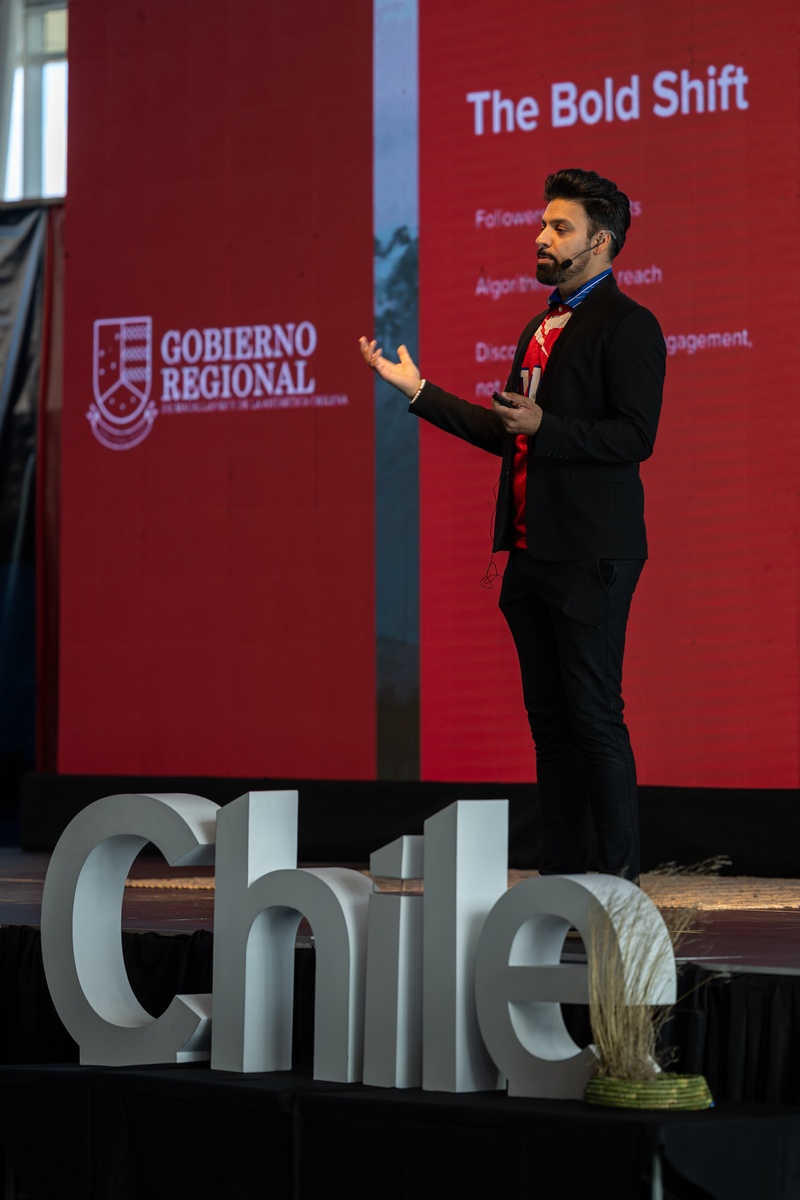
In a high-energy keynote titled “Marketing, Storytelling, AI and Value Creation,” marketing strategist and Tourism Cares board member Aizaz Sheikh made a compelling case: if adventure brands want to win the next wave of demand in 2025 and 2026, they need to understand that social media has quietly become something else entirely.
“We’re not asking customers to do something anymore,” he said. “We’re asking them to stop—to pause mid-scroll long enough to fall in love with our brand, our story, our trips.”
From Social Media to “Interest Media”
Aizaz, a senior marketing leader with experience at G Adventures, Travelzoo and TourRadar, framed his talk around a major shift he believes the industry is underestimating: platforms like Instagram, TikTok, YouTube, and Facebook no longer revolve around who you follow. They revolve around what you’re interested in, moment by moment.
“Followers and communities still matter,” he noted, “but the algorithms don’t serve content based on loyalty alone. They serve it based on interests. That’s why social media has really become interest media.”
For adventure travel companies that spent years building up carefully nurtured online communities, that can sound unsettling. But Aizaz argued it’s actually liberating, especially for smaller operators and destinations that don’t have deep pockets.
In a world where algorithms decide reach, a tiny brand with a sharp sense of its audience can outperform a much larger competitor, if it consistently creates content that aligns with specific traveler interests.
Storytelling in the Algorithm Age
Despite his focus on algorithms and AI, Aizaz insisted that storytelling remains the timeless engine of effective marketing.
“Long before there were ads, there were stories,” he reminded the audience. “We are in the best industry in the world for stories—and yet, when it comes to marketing, we often skip straight to the hard sell.”
The challenge today is not whether stories matter, but how they’re told:
- You have two to three seconds to hook someone before they scroll on.
- The strongest content front-loads its best moment, insight, or curiosity hook instead of saving it for the end.
- Audiences increasingly prefer authentic, human content over ultra-polished, “brochure-style” videos.
Excuses about missing drones and high-end cameras, he suggested, are outdated. The device in every marketer’s pocket is now powerful enough, and often more aligned with what audiences actually want to see.
Five Takeaways to Shape 2026 Adventure Marketing
Aizaz organized his talk around two strategic shifts and three tactical moves that adventure brands can start acting on immediately.
1. Embrace Interest Media
The first strategic shift is to stop marketing to everyone.
“Generic content is vanilla,” he said. “And the algorithms know nobody wants vanilla all the time.”
Even if a company offers hiking, biking, cultural immersion, and food-focused trips, each piece of content should be crafted for a specific micro-interest or traveler segment. The more specific the content, the more likely algorithms are to serve it to the people who care.
Data, he emphasized, is essential here: marketers need to get comfortable inside the platforms, studying performance, audience behavior, and trends themselves—not outsourcing that understanding to “the kids” or a distant social media coordinator.
2. Treat Story as a Strategic Asset
The second strategic shift is to treat storytelling as a core business capability, not something that only happens on the trail or around the campfire.
Aizaz urged companies to sit down with their teams and identify the stories they want to tell:
- Stories about guides and local partners
- Stories about specific places, conservation efforts, or cultural experiences
- Stories about the transformation travelers experience on trip
Those narratives then need to be adapted into short-form content that respects platform norms while staying true to the brand.
Three Tactics You Can Use Right Away
Moving from strategy to execution, Aizaz offered three practical tactics that teams can start testing “as early as Monday.”
3. Collaborate Smartly with Creators
Creators and influencers, he argued, should be viewed as an extended media team—not as a necessary evil or a vanity play. They:
- Are already experts at creating content that stops the scroll
- Know their niche audiences intimately
- Can often explain what’s working—and why—in ways that help brands upskill internally
Aizaz recommended starting small: instead of immediately flying creators across the world, have them test concepts from home using simple formats such as green-screen commentary. Measure not just likes and follows, but clicks, leads, and bookings, and build long-term relationships with those who prove they can move the needle.
4. Turn Organic Wins into Paid Winners
Aizaz sees a persistent gap between brand marketing and performance marketing.
Too often, performance teams commission completely new ads while high-performing organic posts sit unused. With today’s platforms, he argued, that makes little sense.
“If a piece of content has already taken off organically, the platform has already told you it works,” he said. “That’s your proof of concept. That’s what you should be putting spend behind.”
His recommendation: identify top-performing organic content, lightly adapt it with a clear call-to-action, and use it as the foundation for paid campaigns. Then scale spend on the versions that convert.
5. Tap into Trends and Culture—Authentically
Finally, Aizaz encouraged adventure brands to ride cultural waves when it makes sense: major concerts, hit TV series, viral moments, and other pop culture touchpoints that shape how people dream about travel.
The key is to:
- Monitor trends and memes inside the platforms
- Localize them with your own landscapes, food, and stories
- Join conversations in ways that feel natural, not forced
Relatability, he stressed, often equals visibility in the eyes of the algorithm.
Turning Algorithms into Adventures
Aizaz closed with a reminder that adventure travel has a built-in advantage in the attention economy: it already sells transformation, not just transactions.
“We don’t just sell being somewhere new,” he said. “We sell becoming someone new.”
If the industry can already turn curiosity into courage on the trail, he argued, then it can learn to turn algorithms into adventures in the feed—so long as it stops being generic, leans into storytelling, and meets travelers where they now discover the world: on their phones.