
Québec City has officially been recognized as a UNESCO Biosphere Region, a designation reserved for territories that successfully balance biodiversity conservation, community well-being, and sustainable economic development. The recognition, granted on 5 June 2026, covers the greater Québec City area together with Wendake, and reinforces the destination's standing as a leader in responsible and sustainable tourism.
The timing could hardly be better for our community: Québec City is the proud host of the Adventure Travel World Summit (ATWS) 2026, 14-17 September, where the global adventure travel industry will gather in the very destination earning this distinction.
What makes the recognition so remarkable is that biosphere status is rarely granted to urban environments. Québec City stands out as a model of sustainability in an urban context, an exceptional case globally and unique in North America. UNESCO has noted that this is the first time an entire city has been designated a biosphere reserve. It also makes Québec City the first city in the Americas to hold three UNESCO designations: a World Heritage Site (Old Québec, since 1985), a Creative City of Literature (since 2017), and now a Biosphere Region.
A Territory Between Nature and City
The Québec Biosphere Region is a place where a vibrant urban core, rich natural environments, recognized heritage, and Indigenous presence coexist in harmony. Set between the St. Lawrence River and the mountains, crossed by major rivers and bordered by an extensive forest belt, the region is striking in its scale and diversity:
- 566 km² of territory, nearly half of it composed of natural environments
- 3 municipalities and 1 Indigenous community
- More than 635,000 inhabitants
- More than 500 wildlife species
- 1,410 km of waterways, including four major rivers and the St. Lawrence
The Québec Biosphere Region becomes the fifth in the province of Québec and the twentieth in Canada, joining UNESCO's World Network of Biosphere Reserves - a global community of 759 sites across 136 countries where local, innovative solutions are tested so that people and nature can thrive together.
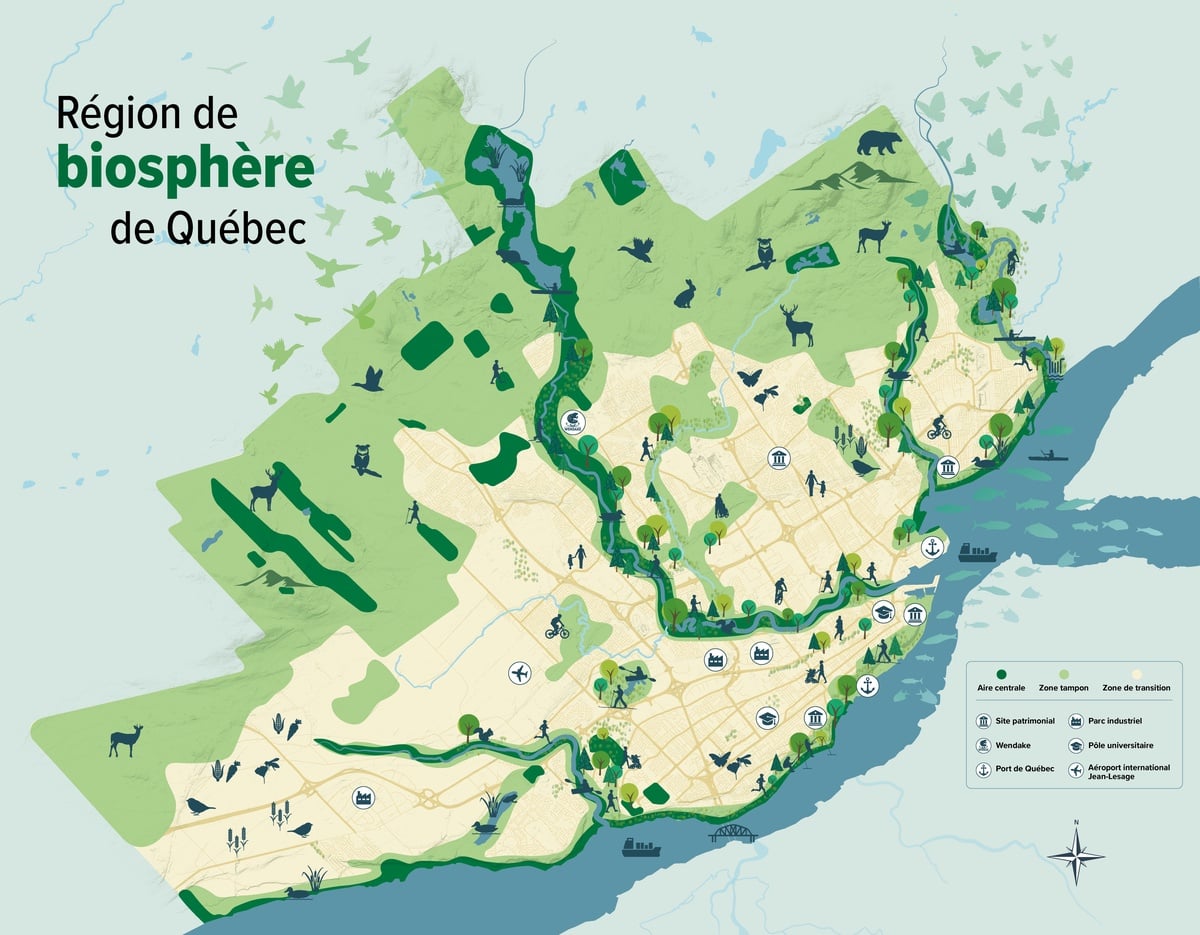
How a Biosphere Region Works
Like all biosphere regions worldwide, the territory is organized into three types of zones designed to balance ecosystem protection with sustainable development. Core areas (about 5% of the territory) are strictly protected natural environments - places such as the Saint-Charles River and the Beauport mudflats, an important bird conservation area. Buffer zones (about 35%) surround the core areas and allow activities compatible with ecological health, such as organic agriculture, ecotourism, and low-impact outdoor recreation. Transition zones (about 60%) are living environments where a broader range of sustainable economic and community activity takes place.
For the adventure travel industry, that structure is significant: it formally protects the wild spaces that draw travellers while actively encouraging the kind of low-impact, nature-based tourism our community champions.
Built on Collaboration and Reconciliation
The designation rests on the mobilization of a broad network of residents, organizations, institutions, businesses, municipalities, and Indigenous communities. In a spirit of reconciliation with the First Nations, the Québec Biosphere Region values Indigenous knowledge and relationships to the land, encourages active community participation, and supports projects that benefit the collective.
The City was guided through the multi-year process by a candidacy committee that included the Huron-Wendat Nation, the Québec Chamber of Commerce and Industry, Université Laval, the Québec Metropolitan Community, the Port of Québec Authority, and other regional partners. The journey began at COP15 in Montréal in December 2022, when the City committed to pursuing the designation alongside its first Biodiversity Strategy, and culminated in the June 2026 decision by the international coordinating council of UNESCO's Man and the Biosphere (MAB) Programme.
Why it Matters for Adventure Travel
For the adventure travel community, this designation is more than a title. It is independent, international confirmation that a destination can pair a dynamic city with protected ecosystems, living heritage, and meaningful Indigenous partnership. Members building itineraries in eastern Canada now have a destination that has formally committed to the harmonious coexistence of culture, conservation, and community - exactly the experience today's responsible travellers are seeking.
There is no better time to experience it first-hand. From the powerful St. Lawrence River to towering waterfalls, vast forests, and the tallest mountains east of the Rockies, Québec offers a four-season playground. As the host of ATWS 2026, it will welcome an estimated 800 tour operators, destination representatives, adventure travel writers, and thought leaders from around the world.
Delegates can take part in Pre-Summit Adventures, the Day of Adventure, the destination Marketplace, MediaConnect, and educational sessions while seeing exactly what earned this region its UNESCO recognition.
Join us in Québec City for ATWS 2026
Connect with the global adventure travel community in a destination setting the standard for sustainable, community-driven tourism. ATWS 2026 runs 14-17 September in Québec City, Canada.