When ATTA released Adventure Travel Market Sizing and the New Adventure Traveler, supported by EF Adventures and CBI, the message was clear: adventure travel is no longer niche. Globally, the majority of international travelers now fall into the “Open to Adventure” category, and the sector has grown into a trillion-dollar force shaping the future of tourism.
That global framing changed the conversation. Adventure is not a specialty product reserved for thrill-seekers; it is a mindset rooted in curiosity, connection, and experience.
ATTA’s newly released Adventure Travel Market Sizing: North America 2026 report builds on that foundation by zooming in on one of the world’s most economically influential outbound regions: the United States and Canada. Rather than repeating the global narrative, the North America report translates it into regional realities: showing who these travelers are, how they spend, what motivates them, and what this means for destinations and operators competing for their attention.
A Majority Mindset With Economic Weight
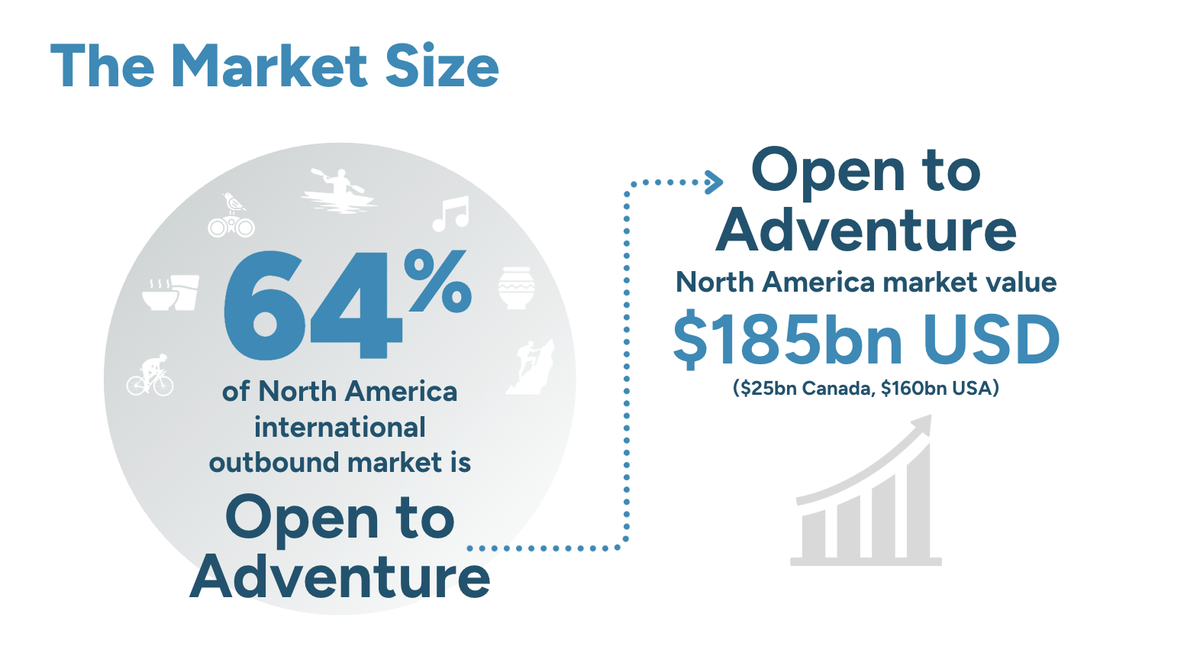
The North America research confirms that adventure-oriented travel is firmly mainstream among U.S. and Canadian outbound travelers. The majority of international travelers from both countries fall into the adventure-aligned category, representing a combined outbound market valued at approximately $185 billion.
For destinations worldwide, this matters. North America remains one of the highest-spending outbound regions globally. When a majority of that market defines travel in experiential terms by blending activity, culture, and personal enrichment, it reshapes how destinations must design, position, and communicate their offerings.
Beyond Adrenaline: How North Americans Define Adventure
The global report emphasized that adventure travel has evolved beyond high-adrenaline pursuits. The North America findings reinforce that shift with regional nuance.
Across traveler segments, motivations consistently blend exploration with cultural immersion, iconic natural and heritage sites, and opportunities for learning or personal growth. Hiking, wildlife, and outdoor activity remain important, but they are rarely standalone drivers. North American travelers increasingly expect layered experiences: a scenic trek paired with local storytelling, a wildlife encounter complemented by community interaction, or a culinary experience embedded in heritage.
This broader definition of adventure is critical for operators. It suggests that the most competitive products will not be defined solely by activity level, but by how thoughtfully they integrate multiple dimensions of experience.
Four Segments, One Experiential Core
While the global research established the scale of the “Open to Adventure” audience, the North America report identifies four primary segments within that majority. Each offers distinct insights for targeting and product design.
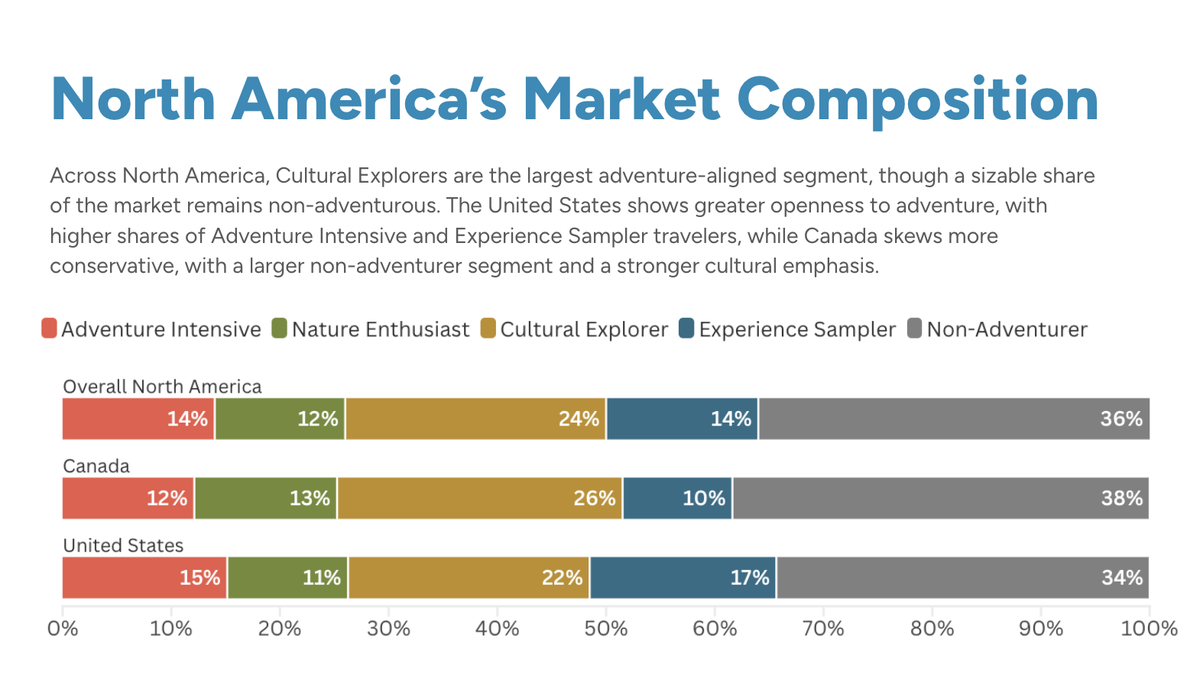
Cultural Explorers (24%) represent the largest adventure-aligned group in North America. These travelers are primarily motivated by cultural immersion and education, with strong interest in heritage-rich destinations and iconic sites. They tend to skew older and value well-structured, thoughtfully designed experiences that balance enrichment with comfort. For destinations with deep historical or cultural assets, this segment represents a particularly strong opportunity.
Adventure Intensives (14%) are the most activity-driven travelers, seeking physically immersive experiences and personal challenge. Yet even within this segment, expectations around quality, seamless logistics, and overall value remain high. Rugged does not mean rough around the edges; high-energy travel must still feel professionally executed and worth the investment.
Nature Enthusiasts (12%) prioritize outdoor engagement and natural landscapes but pair that interest with cultural context and reassurance. They seek enriching experiences delivered with clarity and comfort, reflecting a preference for structured discovery over unpredictability.
Experience Samplers (14%) are motivated by a mix of adventure, personal growth, and cultural engagement. They are drawn to variety and layered itineraries that allow them to combine multiple experience pillars within a single trip.
Taken together, these segments reinforce a unifying insight: North American adventure travelers are less defined by a single activity type and more by an openness to exploration, learning, and meaningful engagement.
The Value–Experience Equation
One of the most consistent findings in the North America report is the central role of value. Across segments and across both countries, cost and affordability remain key decision anchors. Quality and comfort follow closely behind.
Adventure travel in North America operates within what the report describes as a value–experience equation. Travelers are willing to spend, often significantly, but they expect a clear return on that investment. Enrichment must feel proportionate to price. Comfort, transparency, and thoughtful pacing are not luxuries; they are part of how value is assessed.

Spending patterns reinforce this point. U.S. travelers report higher nightly expenditures and overall trip spend, while Canadian travelers tend to stay longer. Across both markets, a substantial share of travel spending flows directly to local businesses, highlighting the tangible economic impact of adventure-oriented travel.
For operators and destinations, the implication is clear: experiences must be both meaningful and measurably worthwhile. Clear inclusions, visible quality standards, and transparent pricing help reinforce trust and competitiveness.
Practical Sustainability
The global research pointed to growing awareness around responsible travel. The North America data clarifies how that awareness translates into behavior.
Travelers in both the U.S. and Canada show willingness to engage in practical sustainability actions such as traveling outside peak seasons, supporting locally sourced products, reducing waste, and participating in community-hosted experiences. Importantly, sustainability resonates most strongly when it is integrated seamlessly into the trip design rather than presented as an abstract add-on.
Canadian travelers demonstrate particularly strong alignment with responsible travel behaviors, often placing greater emphasis on safety, reassurance, and environmental mindfulness. U.S. travelers also engage, especially when responsible options are clearly positioned and convenient.
For destinations, the competitive advantage lies in embedding sustainability into the experience itself through making responsible choices intuitive, visible, and aligned with quality.
Destination Patterns: Aspirational but Measured
North American outbound adventure travelers tend to favor established and well-connected destinations. Western Europe, cross-border travel between the U.S. and Canada, and the Caribbean consistently rank high in interest. Regions such as Central America and the Mediterranean also attract attention for their blend of cultural richness and manageable travel distance.

Interest in more distant regions exists but tends to be more selective. This pattern reflects a balance between aspiration and practicality. Travelers seek discovery and depth, but also accessibility, infrastructure, and perceived ease.
For destinations further afield, reducing friction, whether through clearer safety messaging, stronger air connectivity, or transparent logistics, can play a decisive role in converting interest into bookings.
Two Markets, Complementary Strengths
Although the U.S. drives scale and total outbound spend, Canada adds important depth to the North American story. Canadian travelers skew slightly older and often place greater emphasis on safety, value clarity, and sustainability. U.S. travelers tend to spend more per night and maintain strong expectations around comfort and seamless design.
Together, these markets combine economic power with values-driven travel behaviors, making North America one of the most influential adventure outbound regions globally.
From Global Narrative to Regional Strategy
The trillion-dollar global research established the scale and urgency of adventure travel’s rise. The North America report provides the operational blueprint for engaging one of the world’s most important outbound markets.
For destinations and operators, the strategic implications are straightforward:
- Experience design must take precedence over activity volume. Cultural context, storytelling, and community connection enhance competitive differentiation. Sustainability should be embedded and practical. Pricing must align clearly with enrichment and comfort.
- Adventure in North America is not defined by extremity. It is defined by openness to culture, to nature, to learning, and to transformation.
The global story showed that adventure travel has become mainstream. The North America data shows how that mainstream mindset translates into real spending power, structured expectations, and measurable opportunity. For those willing to align meaning with value, the opportunity is substantial, and growing.