
This is Hurtigruten part one: an original coastal voyage, told across five ATTA News Stories, exploring Hurtigruten's leadership, evolution, and collaboration with ATTA in the adventure travel trade. Published in collaboration with the Adventure Travel Trade Association®.
In this first story, Hurtigruten tells us how a 130-year-old-plus Norwegian coastal cruise operator is sharpening its identity — and what it means for advisors and partners building itineraries around authentic, responsible travel.
When Hurtigruten and HX formally separated into two independent companies in early 2024, the move was less a reinvention than a clarification. HX stepped forward as a dedicated global expedition brand. Hurtigruten, the legacy company operating since 1893, continued its iconic operation along Norway's coastline, its communities, and the original coastal voyage that made the name synonymous with Norway in the first place.
For the travel trade, this separation is worth understanding. Not as a corporate restructuring footnote, but as a signal about where Hurtigruten is headed and how advisors can more confidently position the product.
"Since Hurtigruten is the legacy brand, having operated since 1893, it was natural to revert to the name Hurtigruten rather than Hurtigruten Norway," said Carly Biggart, Head of Hurtigruten Americas. "By separating the brands, we can focus purely on what we are the experts on: Norway and its beautiful coastline."
A Clearer Story for Advisors to Tell
The practical value of this evolution for trade partners lies in what it removes as much as what it adds. When Hurtigruten Group previously operated both a coastal and expedition cruise brand, advisors were navigating two distinct product types that served different traveler profiles. The separation gave each brand a sharper focus.
Hurtigruten's lane is now unmistakable: the year-round Original Voyages along Norway's coast, calling at 34 ports between Bergen and Kirkenes, operating the same route that has served as a lifeline to remote coastal communities for over a century; and the Signature Voyages it launched in 2023, a more premium, all-inclusive and traditional cruise product that operates the Svalbard Line during the extended summer season, and the North Cape Line the remainder of the year. The ships are much smaller than mainstream cruise vessels, allowing them to take guests that most other cruise ships cannot reach, with itineraries that are port-rich, and the experience is shaped by local suppliers, local guides, and the rhythms of actual Norwegian coastal life. A 2025 study found that Hurtigruten and its guests generate NOK 2.6 billion (equal to around €219 million, £192 million, $257 million, A$398 million) annually through purchases of goods and services along Norway’s coast. In 2024, nearly 200,000 guests travelled with Hurtigruten, generating 684,000 guest nights, which in turn supported over 4,000 jobs.
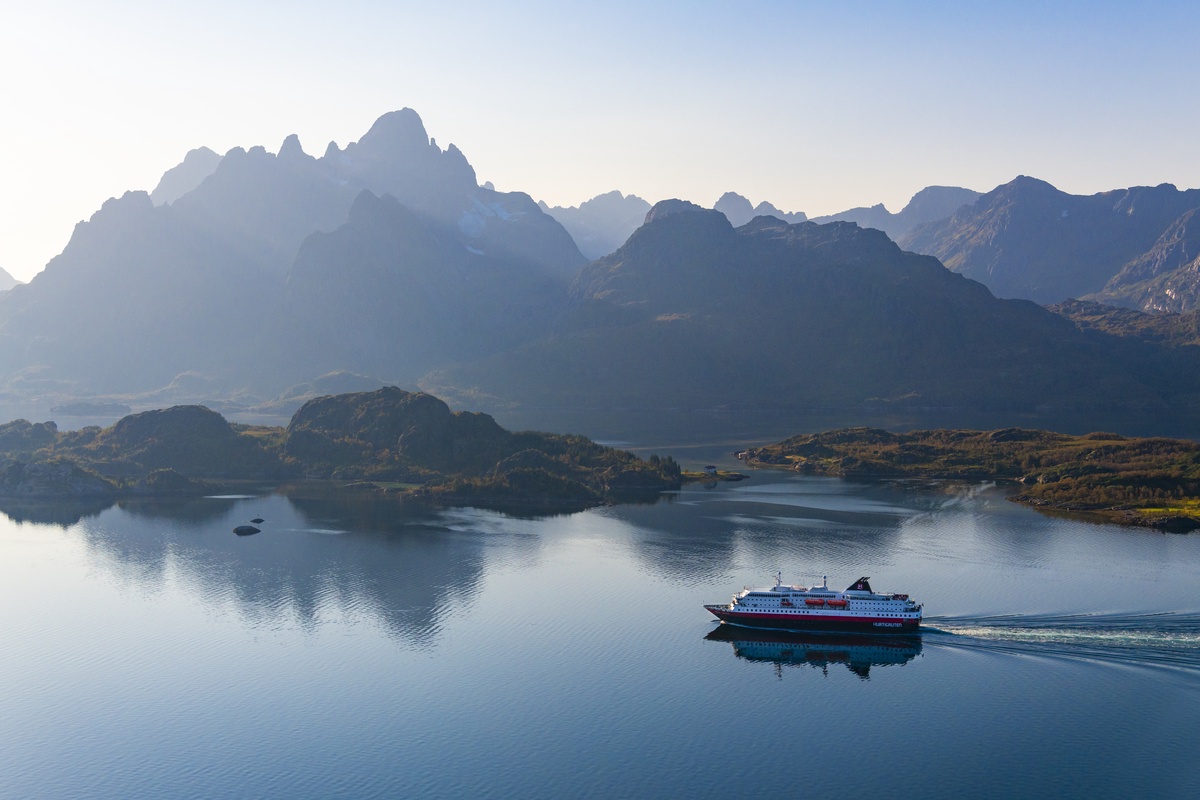
"We hope the travel trade more clearly understands that Hurtigruten is not a brand that is new to Norway. We are Norway,” Biggart said. “This evolution reinforces that our voyages are not simply scenic routes, but living journeys shaped by generations of knowledge, local communities, and operational expertise."
For advisors, that distinction matters. The pitch is no longer "a cruise that visits Norway." It is an original coastal voyage, embedded in the country's history, story, and daily life, with a clear sense of place that few operators at any price point can replicate.
Heritage as a Differentiator, Not a Constraint
One of the central challenges of any brand identity is determining what to keep. "Our role as a lifeline for coastal communities was essential to preserve," said Biggart. "That sense of service, responsibility, and continuity sits at the heart of Hurtigruten. Equally important was our pioneering spirit - from opening remote regions to international visitors to advancing sustainable practices and setting the standard for exploration long before it became a trend."
That pioneering spirit is now channelled into a sustainability roadmap that speaks directly to where the adventure travel trade is heading. The flagship project is Sea Zero, Hurtigruten's zero-emission ship currently in the end of its R&D phase,, with an ambition to sail emissions-free on the Norwegian coast by 2030. Model testing has been completed, and the design, which incorporates the largest battery packs at sea, sail-mounted solar panels, air lubrication systems, an AI-supported navigational bridge, and a refined hull form, represents one of the more credible decarbonization programs in the cruise sector.
The company has just been recognised as Norway's most sustainable travel brand for the third consecutive year, a credential that carries weight with advisors whose clients are scrutinising environmental claims more carefully than ever.
Alongside Sea Zero, Hurtigruten has deepened its food and beverage program through Norway's Coastal Kitchen, a sourcing model that draws from small local producers along the route. With its latest Culinary Ambassador, Máret Rávdná Buljo, who is Sámi (the Indigenous people of the Arctic Nordics) they recently launched menus that integrate traditional Sámi ingredients, preparation methods, and storytelling into onboard dining—giving advisors a concrete, culturally specific talking point for clients interested in Indigenous heritage and responsible cultural engagement.
How the Positioning Translates Across Markets
One of the practical strengths of a focused brand identity is that it travels. While Hurtigruten's core message of heritage, authenticity, and connection to nature stays consistent, the emphasis can shift by market without losing coherence.
"In some markets, the focus is legacy and trust," said Biggart. "In other markets, it is sustainability, exploration, or immersive learning. The evolution provides a flexible framework that allows local teams and partners to highlight what resonates most while staying true to a clear and consistent Hurtigruten identity."
For North American advisors specifically, the brand evolution supports a value proposition built around purpose-driven travel and meaningful destination immersion. In European markets with strong environmental expectations, Sea Zero's sustainability credentials carry more weight. For specialist operators building itineraries around culinary or cultural programming, the Coastal Kitchen and Sámi partnerships provide the content.
This flexibility is a meaningful asset in a trade environment where partners are building proposals across diverse client profiles. A single brand with multiple credible entry points is easier to work with than a product that requires extensive re-explaining, depending on the client.
Built From the Inside Out
One of the more revealing aspects of Hurtigruten's brand work was its development process. Rather than being driven top-down by a marketing brief, the process drew heavily on the perspectives of frontline staff, crew, and onboard experts.
"Our crew, expedition teams, and onboard experts live the brand every day, and their perspectives ensured authenticity throughout the process. Their stories, insights, and local knowledge helped shape a brand expression that feels human, credible, and rooted in real experience," said Biggart.
The result was consistent. "Themes of trust, responsibility, and pride surfaced again and again, regardless of role, team, or market," Biggart added. "It reinforced that this brand lives far beyond marketing and is deeply embedded in how we operate and how our teams view their role in protecting and sharing the Norwegian coast."
For trade partners, that internal alignment matters. When the people delivering an experience share a clear and consistent understanding of what the brand stands for, the product is more likely to meet the promise made at the point of sale.
As the travel trade continues to field demand for experiences that are more meaningful, responsible, and hard to replicate, Hurtigruten's refined identity offers partners a product that is easier to sell with confidence. The 130-year-plus legacy is not a constraint on growth; it is, increasingly, the competitive advantage.
A Brand Built for Where the Trade Is Heading
For ATTA members, where responsible adventure tourism is defined by connection to nature, immersive cultural experience, and measurable benefits to local people, Hurtigruten's evolution reads less like a rebrand and more like a case study in putting those values into practice along one of the world's most storied coastlines. The Ripple Report's community economic impact, the Sea Zero decarbonization roadmap, the Sámi Culinary Ambassador program, and the Open Village model each map directly onto ATTA's core priorities around climate action, community benefit, and Indigenous partnership, giving advisors concrete, defensible ways to deliver on those principles when clients ask about Norway. For more information on The Ripple Report and other sustainability initiatives, read the next article: On the National Stage.